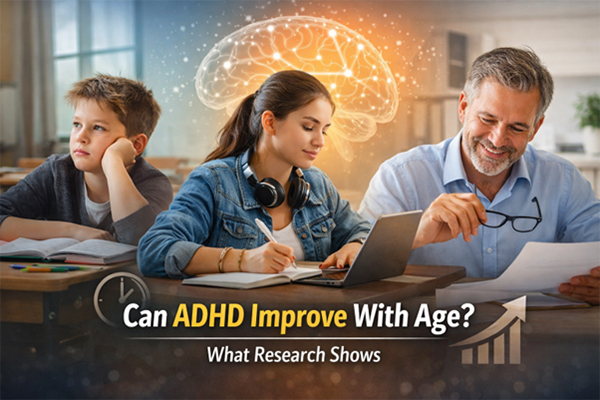
Attention-Deficit/Hyperactivity Disorder (ADHD) is often thought of as a childhood condition, but many individuals and families wonder: Can ADHD improve with age? The answer is not a simple yes or no. Research shows that while ADHD does not typically “go away,” its symptoms can change, evolve, and in some cases become more manageable over time - especially with proper support.
As a psychiatrist in Boca Raton, Dr. Priti Kothari works with children, adolescents, and adults to help them understand how ADHD presents across different life stages and what evidence-based strategies can improve long-term outcomes.
Understanding ADHD Across the Lifespan
ADHD is a neurodevelopmental condition characterized by inattention, hyperactivity, and impulsivity. These symptoms usually appear in childhood, but how they show up can look very different in adulthood.
- Children may display visible hyperactivity, difficulty following rules, and impulsive behavior.
- Adolescents often struggle with organization, emotional regulation, and academic demands.
- Adults may experience internal restlessness, poor time management, forgetfulness, or difficulty maintaining focus at work and in relationships.
Because symptoms evolve, ADHD can sometimes appear to improve, even though the underlying condition remains.
What Does the Research Say?
ADHD Symptoms Often Change With Age
Long-term studies suggest that hyperactivity tends to decrease as children grow older. Many adults no longer feel the need to constantly move, but instead experience mental restlessness or difficulty relaxing.
However, inattention often persists into adulthood. Tasks that require sustained focus, planning, or organization can continue to be challenging without treatment or coping strategies.
Some Individuals Experience Significant Improvement
Research indicates that a subset of individuals may no longer meet full diagnostic criteria for ADHD in adulthood. This improvement is often linked to:
- Brain maturation, particularly in the prefrontal cortex
- Learned coping skills
- Supportive environments
- Early diagnosis and treatment
That said, improvement does not necessarily mean the ADHD is “cured.” Many adults still experience subtle symptoms that affect daily functioning.
Untreated ADHD Is Less Likely to Improve
Studies consistently show that early intervention leads to better outcomes. Children who receive appropriate treatment - such as behavioral therapy, academic accommodations, and medication when appropriate - are more likely to develop strong self-management skills later in life.
Without support, ADHD symptoms may contribute to academic struggles, low self-esteem, anxiety, depression, or difficulties in work and relationships.
Why ADHD May Feel Better With Age
Several factors explain why ADHD can seem less severe over time:
- Improved Self-Awareness
Adults often recognize their strengths and limitations and learn how to work around them. - Structured Environments
Choosing careers, routines, and lifestyles that align with one’s attention style can reduce daily stress. - Skill Development
Time-management tools, therapy, coaching, and medication can significantly improve functioning. - Brain Development
The brain continues developing into the mid-20s, which may support better impulse control and decision-making.
When ADHD Does Not Improve
For some individuals, ADHD symptoms remain significantly impairing into adulthood. This is especially true when ADHD is accompanied by:
- Anxiety or depression
- Learning disorders
- Trauma or chronic stress
- Lack of access to mental health care
In these cases, ongoing psychiatric care is essential. Working with a qualified psychiatrist in Boca Raton can help individuals tailor treatment to their changing needs at every life stage.
ADHD in Adults: A Growing Area of Awareness
Many adults are only diagnosed later in life, often after years of struggling without answers. Increased awareness and research now show that adult ADHD is real, common, and treatable.
Treatment may include:
- Medication management
- Cognitive behavioral therapy (CBT)
- Executive functioning coaching
- Lifestyle and routine adjustments
With the right approach, adults with ADHD can thrive personally and professionally.
Frequently Asked Questions
Can ADHD completely go away with age?
For most people, ADHD does not completely disappear. However, symptoms may become milder or easier to manage over time, especially with treatment and coping strategies.
Why does hyperactivity decrease but inattention remain?
Hyperactivity is often more physical in children and tends to fade as the brain matures. Inattention, which involves focus and organization, relies on executive functioning skills that may remain challenging.
Is adult ADHD different from childhood ADHD?
The core condition is the same, but symptoms often present differently. Adults may struggle more with time management, relationships, and work performance rather than overt hyperactivity.
Does treatment help ADHD improve long-term?
Yes. Research shows that early and consistent treatment improves long-term outcomes and quality of life.
When should I see a psychiatrist for ADHD?
If ADHD symptoms interfere with school, work, relationships, or emotional well-being, it is important to seek evaluation from a qualified psychiatrist.
About Dr. Priti Kothari
Dr. Priti Kothari is a board-certified child, adolescent, and adult psychiatrist in Boca Raton, specializing in evidence-based, compassionate mental health care. She provides comprehensive evaluations and individualized treatment plans for ADHD, anxiety, depression, and related conditions across the lifespan.
Dr. Kothari emphasizes careful diagnosis, patient education, and collaborative care to help individuals and families achieve meaningful, long-term improvement in mental health and daily functioning.
References
- American Psychiatric Association.
Attention-Deficit/Hyperactivity Disorder (ADHD).
https://www.psychiatry.org/patients-families/adhd/what-is-adhd - Centers for Disease Control and Prevention (CDC).
ADHD Across the Lifespan.
https://www.cdc.gov/adhd/living-with/index.html - Faraone SV, Biederman J, Mick E.
The age-dependent decline of attention deficit hyperactivity disorder: A meta-analysis of follow-up studies.
Psychological Medicine. 2006;36(2):159–165.
https://pubmed.ncbi.nlm.nih.gov/16420712/ - Sibley MH, et al.
Defining ADHD symptom persistence in adulthood.
American Journal of Psychiatry. 2017;174(1):70–78.
https://pubmed.ncbi.nlm.nih.gov/27539088/ - Barkley RA, Murphy KR, Fischer M.
ADHD in Adults: What the Science Says.
Guilford Press.
https://www.guilford.com/books/ADHD-in-Adults/Barkley-Murphy-Fischer/9781609180751 - National Institute of Mental Health (NIMH).
Attention-Deficit/Hyperactivity Disorder.
https://www.nimh.nih.gov/health/topics/attention-deficit-hyperactivity-disorder-adhd