
Executive functioning is the set of mental processes that guide goal‑directed behavior. In attention‑deficit/hyperactivity disorder (ADHD), these processes often operate below typical levels. Understanding the specific deficits that accompany ADHD helps clinicians, educators, and families target interventions that build daily competence.
What Are Executive Functions?
Executive functions include five core abilities: planning, organizing, working memory, inhibition, and self‑regulation. These skills allow an individual to set intentions, sequence actions, hold information in mind, control impulses, and adjust behavior in response to feedback. Russell Barkley identifies executive functioning as the “brain’s management system” that coordinates cognition, emotion, and behavior.
- Planning involves setting goals, anticipating steps, and allocating resources.
- Organizing requires arranging items or information in an accessible, logical manner.
- Working memory holds and manipulates data over short periods.
- Inhibition suppresses automatic or impulsive responses.
- Self‑regulation monitors and adjusts performance according to external demands or internal goals.
ADHD interferes with one or more of these abilities, leading to challenges in school, work, and everyday life.
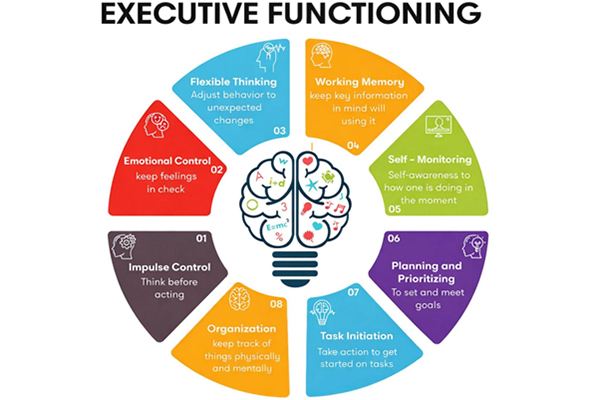
Executive Function Deficits Linked to ADHD
Research by Barkley and others identifies seven distinct deficits that frequently co‑occur with ADHD:
- Weakness in response inhibition – difficulties stopping or redirecting a behavior.
- Reduced working‑memory capacity – problems maintaining information while completing a task.
- Impaired planning and organization – struggles to structure actions or keep materials in order.
- Low persistence – quick disengagement from tasks that do not provide immediate reward.
- Poor time management – trouble estimating task duration or meeting deadlines.
- Limited self‑monitoring – lack of awareness about errors or where performance is lacking.
- Weak self‑regulation of emotions – heightened emotional responses that interfere with tasks.
These deficits explain many of the daily difficulties reported by people with ADHD, from missing deadlines to forgetting appointments.
Why Executive Function Matters in ADHD
Executive functioning connects brain activity to real‑world behavior. In ADHD, the neural circuitry that supports the “executive system” - particularly the prefrontal cortex - is underactive or structurally altered. This neural profile produces the deficits noted above. When executive processes are impaired, the individual may:
- Struggle to initiate tasks or maintain attention.
- Have difficulty completing complex projects.
- Experience frustration when expectations are unmet.
- Encounter issues at school, at work, or in social settings.
Because executive functions underlie most daily activities, deficits in ADHD impact academic achievement, occupational success, and personal relationships.

Practical Strategies for Strengthening Executive Functions
Evidence‑based approaches can strengthen executive functioning in ADHD. Below are strategies that families, teachers, and clinicians can apply.
1. Use Structured Routines
A predictable schedule reduces the load on working memory. Setting times for homework, chores, and sleep helps the brain anticipate and prepare for upcoming tasks.
2. Break Tasks into Manageable Steps
Dividing a large assignment into smaller actions limits the need for sustained planning. Each step can be completed independently, allowing the individual to experience success and maintain motivation.
3. Create Visual Supports
Visual timers, checklists, and color‑coded labels provide external cues that compensate for weak internal monitoring. When tasks are visually mapped, the need for self‑regulation decreases.
4. Teach Self‑Check Techniques
Prompting periodic self‑assessment - such as “Did I finish this step?” - builds awareness. Over time, individuals learn to detect mistakes before they become larger problems.
5. Encourage Reflection Sessions
After completing an activity, reviewing what went well and what could improve trains the brain to adjust future behavior. Reflection strengthens the link between action and outcome.
6. Model Effective Organization
When adults demonstrate organization - such as placing a folder on a desk before a meeting - the child observes the process and can emulate the steps. Modeling gives a concrete example of how to apply executive skills.
7. Use Timed Intervals
Setting a timer for a short period encourages focus. Once the timer ends, the individual can evaluate progress and decide whether to continue or take a break. This practice sharpens inhibition and time‑management skills.
8. Provide Immediate Feedback
Quick, clear feedback after a task helps the individual monitor performance. Delayed feedback may reduce its impact on learning strategies.
9. Integrate Physical Activity
Movement improves prefrontal cortex function, enhancing executive processes. Short activity breaks during long tasks can reset attention and improve subsequent performance.
10. Consider Coaching
Executive‑function coaching offers personalized guidance. Coaches help set realistic goals, track progress, and adjust strategies when challenges arise.

The Role of Coaching and Professional Support
Professional coaching builds on the foundation of self‑help strategies by adding tailored instruction. A coach works with the adult or child to map specific deficits, develop actionable plans, and practice new skills in real‑time settings. Coaching can be especially valuable when deficits are severe or when self‑directed strategies alone do not yield sufficient improvement.
Executive functioning - planning, organizing, working memory, inhibition, and self‑regulation - forms the backbone of daily success. In ADHD, deficits in these areas explain many academic and personal difficulties. Structured routines, task segmentation, visual aids, self‑check techniques, reflection, modeling, timed intervals, feedback, physical activity, and coaching provide a comprehensive toolkit for strengthening executive functions.
For individuals with ADHD seeking improved daily performance, understanding and targeting executive deficits is essential. The strategies outlined above are grounded in research and can be implemented in home, school, or workplace environments.
For further guidance on managing ADHD and executive functioning, consult Dr. Priti Kothari, board‑certified child, adolescent, and adult psychiatrist in Florida.
References
1. Barkley, R. A. (2012). Executive Functions: What They Are, How They Work, and Why They Evolved. Guilford Press. https://www.guilford.com/books/Executive-Functions/Russell-Barkley/9781462545933
2. Barkley, R. A. ADHD, Executive Functions, and Self-Regulation.
Russell Barkley, PhD – Official Fact Sheet.
https://www.russellbarkley.org/factsheets/ADHD_EF_and_SR.pdf
3. Barkley, R. A. (2011). The Seven Executive Function Deficits Tied to ADHD.
ADDitude Magazine.
https://www.additudemag.com/7-executive-function-deficits-linked-to-adhd/
4. Child Mind Institute. ADHD and Executive Function.
https://childmind.org/article/adhd-and-executive-function/
5. Perler, S. What Is Executive Functioning?
Seth Perler – Executive Function Coach & Educator.
https://sethperler.com/executive-function-holy-grail/
6. Perler, S. Top Executive Function Strategies for ADHD.
https://sethperler.com/top-10-executive-function-tips/