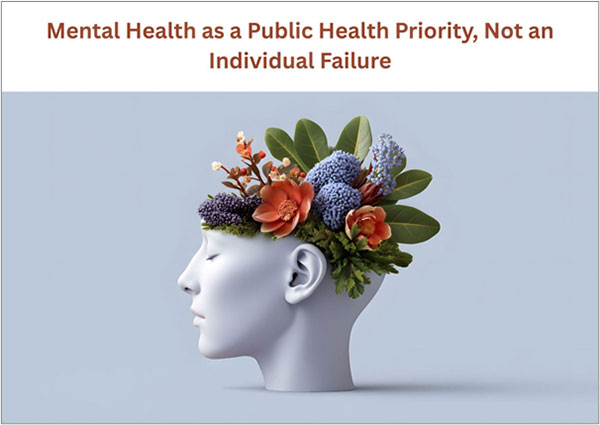
Mental health is often discussed in deeply personal terms—resilience, coping skills, mindset, or personal responsibility. While individual treatment and self-care are important, this framing is incomplete and, in many cases, harmful. Mental illness is not merely an individual problem; it is a public health issue with wide-ranging social, economic, and intergenerational consequences.
Viewing mental health through a public health lens allows for prevention, early intervention, equity, and sustainable systemic solutions.
Mental Illness at the Population Level
Mental health conditions are among the leading causes of disability worldwide. Depression, anxiety disorders, substance use disorders, and serious mental illness collectively affect hundreds of millions of people and account for a substantial proportion of lost productivity, healthcare utilization, and premature mortality.
At a population level, untreated or inadequately treated mental illness contributes to:
- Reduced educational attainment
- Workforce absenteeism and presenteeism
- Increased rates of chronic medical illness
- Higher emergency department utilization
- Elevated suicide and overdose rates
These outcomes ripple outward, affecting families, schools, employers, and entire communities. When mental health systems fail, the burden does not disappear—it shifts to emergency rooms, schools, law enforcement, and social services.
Social Determinants of Mental Health
Public mental health recognizes that psychiatric outcomes are strongly influenced by social determinants, including:
- Poverty and financial insecurity
- Housing instability
- Food insecurity
- Exposure to violence or discrimination
- Limited access to healthcare and education
Individuals living in disadvantaged environments experience higher rates of mental illness and lower access to care, reinforcing cycles of inequity. Framing mental illness as a personal failing obscures these structural drivers and places blame on individuals for conditions shaped by their environments.
Structural Barriers to Care
Despite increased awareness of mental health, access to care remains uneven. Key barriers include:
- Severe shortages of psychiatrists, psychologists, and therapists
- Long wait times for appointments
- Insurance restrictions and inadequate reimbursement
- Geographic disparities, particularly in rural areas
- Cultural stigma and language barriers
Even when individuals seek help, systems may be fragmented, underfunded, or inaccessible. Public health approaches emphasize system design, not just individual motivation.
The Case for Prevention and Early Intervention
One of the core principles of public health is prevention. In mental health, this means identifying risk factors early and intervening before conditions become severe or chronic.
Examples include:
- School-based mental health screening and counseling
- Early childhood interventions for emotional regulation and attachment
- Community programs addressing trauma and adverse childhood experiences (ACEs)
- Substance use prevention initiatives
Preventive care not only reduces suffering but is also more cost-effective than crisis-based treatment.
Integrated and Collaborative Care Models
Public mental health prioritizes integration rather than isolation of services. Collaborative care models embed mental health treatment within primary care settings, allowing earlier identification and coordinated management of psychiatric conditions.
These models have been shown to:
- Improve treatment outcomes
- Reduce stigma
- Increase access, especially for underserved populations
- Lower overall healthcare costs
By normalizing mental health treatment within general healthcare, integration reinforces the idea that mental health is inseparable from physical health.
Mental Health Policy and Systems Accountability
Policy decisions profoundly shape mental health outcomes. Funding priorities, insurance regulations, workforce training, and public education campaigns all influence who receives care and when.
Effective public mental health policy includes:
- Parity between mental and physical health coverage
- Investment in community mental health services
- Expansion of the mental health workforce
- Crisis response systems that prioritize care over criminalization
Without systemic accountability, individual treatment efforts are insufficient to address population-level needs.
Reframing Responsibility
Recognizing mental health as a public health issue does not absolve individuals of agency, nor does it diminish the importance of therapy or medication. Instead, it redistributes
responsibility—acknowledging that governments, healthcare systems, schools, and communities all play essential roles in promoting mental well-being.
This reframing reduces stigma by shifting the narrative from “personal weakness” to “collective responsibility.”
Conclusion
Mental health is not a niche concern or a private struggle—it is a foundational determinant of societal health. Treating mental illness solely at the individual level ignores the systemic forces that shape risk, access, and outcomes. A public health approach emphasizes prevention, equity, integration, and policy reform, creating conditions in which individuals can realistically thrive. Addressing mental health at the population level is not only compassionate—it is necessary for sustainable social well-being.
References
World Health Organization. (2022). World mental health report: Transforming mental health for all. https://www.who.int
Centers for Disease Control and Prevention. (2023). Mental health surveillance among adults. https://www.cdc.gov/mentalhealth
National Institute of Mental Health. (2023). Mental illness statistics. https://www.nimh.nih.gov
Patel, V., Saxena, S., Lund, C., Thornicroft, G., Baingana, F., Bolton, P., … Unützer, J. (2018). The Lancet Commission on global mental health and sustainable development. The Lancet, 392(10157), 1553–1598. https://doi.org/10.1016/S0140-6736(18)31612-X
Marmot, M., Allen, J., Goldblatt, P., Boyce, T., & McNeish, D. (2010). Fair society, healthy lives: Strategic review of health inequalities in England. The Marmot Review.
Unützer, J., Harbin, H., Schoenbaum, M., & Druss, B. (2013). The collaborative care model: An approach for integrating physical and mental health care in Medicaid health homes. Health Home Information Resource Center. Centers for Medicare & Medicaid Services.