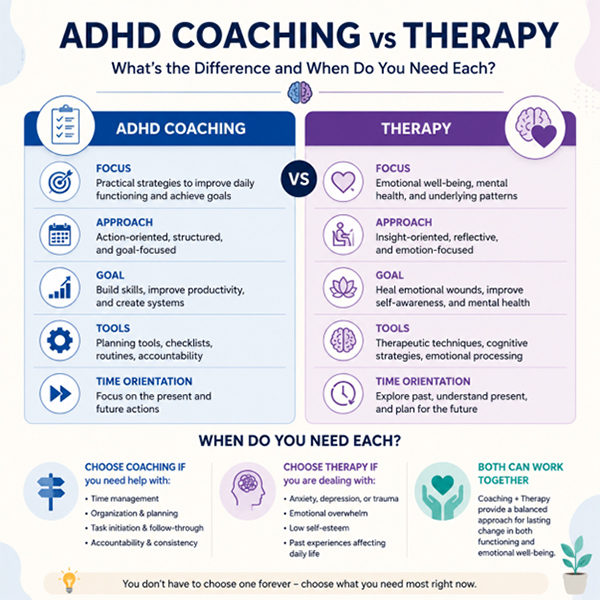
ADHD coaching and therapy are both valuable forms of support, but they serve different purposes and address different aspects of functioning. While both can significantly improve quality of life for individuals with ADHD, understanding their distinct roles is essential for choosing the right type of care at the right time.
What Does This Mean?
ADHD coaching focuses on practical skills, structure, and accountability to improve daily functioning, while therapy focuses on emotional health, psychological patterns, and mental health conditions. Coaching helps individuals build systems to manage tasks and executive function challenges, whereas therapy helps individuals process emotions, trauma, anxiety, or depression that may co-occur with ADHD.
Core Differences Between ADHD Coaching and Therapy
Focus of Support
ADHD Coaching: Emphasis on organization, planning, time management, and task completion.
Therapy: Focus on emotional well-being, mental health conditions, and deeper psychological patterns.
Approach to Change
ADHD Coaching: Action-oriented, structured, and goal-based.
Therapy: Insight-oriented, reflective, and emotion-focused.
Primary Goal
ADHD Coaching: Improve daily functioning and executive skills.
Therapy: Improve emotional regulation and mental health stability.
Tools Used
ADHD Coaching: Checklists, routines, accountability systems, productivity strategies.
Therapy: Cognitive-behavioral techniques, trauma processing, emotional exploration.
Time Orientation
ADHD Coaching: Present and future-focused (what to do now and next).
Therapy: Past, present, and future (understanding patterns and healing experiences).
How This Affects Daily Life
Understanding the difference helps individuals choose the right type of support for their needs. Many people with ADHD experience challenges such as:
- Difficulty staying organized and completing tasks
- Emotional overwhelm and frustration
- Chronic procrastination and time management issues
- Anxiety or low mood linked to ongoing struggles
Recognizing whether these issues are primarily behavioral/executive or emotional/psychological helps guide appropriate intervention.
Strategies and Support Options
When ADHD Coaching Is More Helpful
- You struggle with routines, planning, and follow-through
- You need accountability and structure
- You know what to do but can’t consistently execute it
When Therapy Is More Helpful
- You experience anxiety, depression, trauma, or emotional distress
- You need support processing past experiences
- Emotional regulation is a primary challenge
When Both Are Needed
Many individuals benefit most from a combined approach where therapy addresses emotional health and coaching strengthens daily functioning and executive skills.
Integrated Support Approach
Coaching and therapy can complement each other by addressing both internal emotional barriers and external behavioral systems, leading to more sustainable improvement.
In conclusion, ADHD coaching and therapy are not interchangeable—they are complementary. Coaching builds structure and execution skills, while therapy supports emotional healing and psychological insight. Understanding when to use each allows individuals with ADHD to receive more targeted, effective, and balanced support.
About Dr. Priti Kothari
Dr. Priti Kothari is a board-certified child, adolescent, and adult psychiatrist in Boca Raton. She specializes in ADHD, anxiety, depression, and executive functioning challenges, providing integrated care that supports both emotional health and daily functioning.
Frequently Asked Questions
Do I need therapy if I already have ADHD coaching?
If emotional distress is present, therapy may still be necessary alongside coaching.
Can coaching replace therapy?
No. Coaching focuses on skills and structure, not mental health treatment.
Which works faster—coaching or therapy?
Coaching often shows quicker behavioral changes, while therapy works on deeper long-term emotional patterns.